TradingKey - On October 13, US Eastern Time, SpaceX (SPCX) launched a Dragon spacecraft using a Falcon 9 rocket to execute the CRS-35 commercial resupply mission to the International Space Station. This launch continued Falcon 9's mature hardware reuse model, while the next growth catalyst favored by institutions is whether Starship can achieve full reusability, thereby lowering launch costs and supporting the expansion of Starlink and AI operations.
However, the successful launch was not accompanied by a stock price increase. As of press time, SpaceX shares fell 4.21% intraday to $156.54. Technological breakthroughs for Starship and the realization of its commercial value remain key highlights to watch going forward.
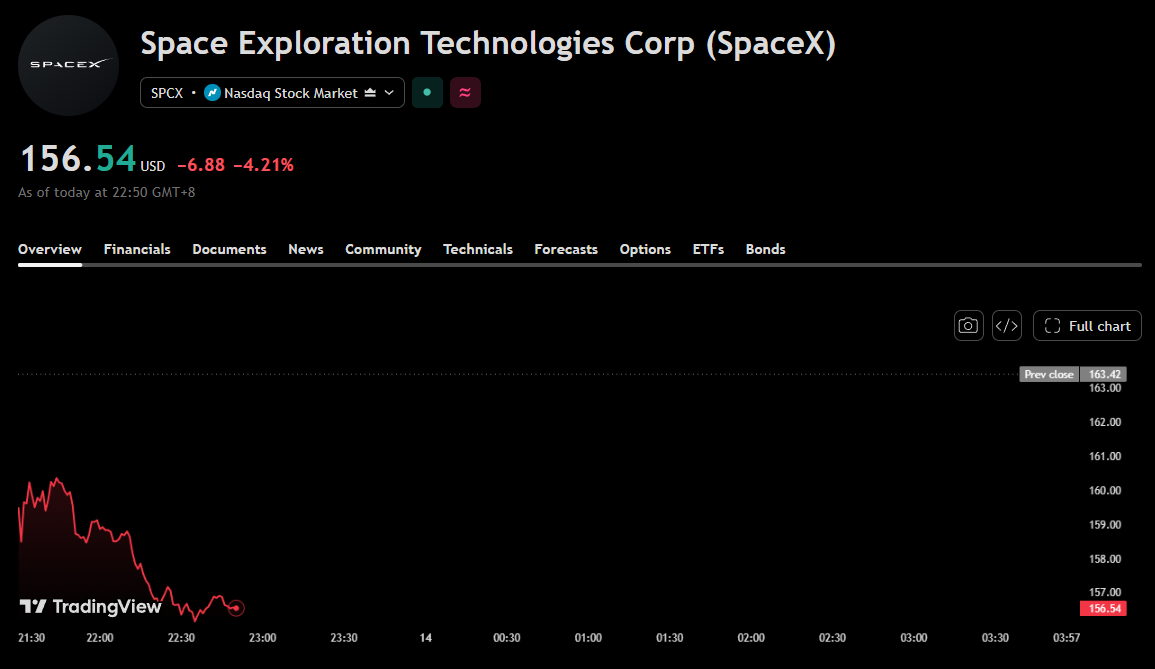
SpaceX stock chart, Source: TradingView
Falcon 9 Launch: Reused Hardware Executes Resupply Mission
According to mission details, the rocket lifted off from Florida at 6:33 a.m. Eastern Time, executing SpaceX's 35th commercial resupply mission under its long-term contract with NASA.
This flight marks the fourth for the Dragon spacecraft, which previously completed the CRS-26, CRS-29, and CRS-33 missions. The first-stage booster completed its eighth flight and returned to Landing Zone 40 following separation.
The Dragon spacecraft is expected to fly for approximately 52 hours and autonomously dock with the space station at 11:00 a.m. Eastern Time on October 15, returning with scientific research samples and hardware after staying for about a month.
Starship Launch: Next Step to Test Full Reusability
Falcon 9 once again used existing hardware for this launch, while Starship is still working to master complete reusability. Reportedly, SpaceX's 15th test flight is tentatively scheduled for November 8 local time, during which it may attempt to catch the returning upper-stage spacecraft using the launch tower's mechanical arms, though neither the date nor the recovery arrangements have been confirmed by SpaceX.
Citi noted that the most notable technical objective of the next test flight is the first attempt to catch the Starship upper-stage spacecraft using the launch tower's "chopsticks" mechanical arm system. Previously, SpaceX conducted launch-tower recovery technology validations centered on the Super Heavy booster, but recovering the upper-stage spacecraft is even more difficult, involving post-reentry attitude control, precise deceleration, and coordinated operation with the launch tower's mechanical arms.
Citi expects SpaceX may attempt this technology during its 15th test flight, viewing it as a critical step toward achieving complete reusability and rapid turnaround for Starship.
In addition, during the 14th test flight, SpaceX deployed 26 Starlink V3 satellites. Morgan Stanley estimates that Starship can carry up to 60 such satellites, each with roughly 10 times the downlink bandwidth capacity of the V2 Mini. If large payload and reusability capabilities materialize, they are expected to lower Starlink expansion costs and support businesses such as orbital computing.
Morgan Stanley pointed out that further progress in Starship development, new AI product launches, and additional cloud infrastructure contracts priced at approximately $30 to $50 per watt are potential catalysts that could drive the stock toward its $300 price target. The bank also believes that expanding satellite connectivity and deploying computing infrastructure in orbit offer further opportunities.
Find out more